
Sapa in Winter: Complete Travel Guide for First-Timers
Sapa in winter possesses a unique beauty — mysterious, enchanting, yet pure and naturally mesmerizing. If you’re lucky enough to witness Sapa on a snowy day, it will leave you with unforgettable memories for a lifetime.
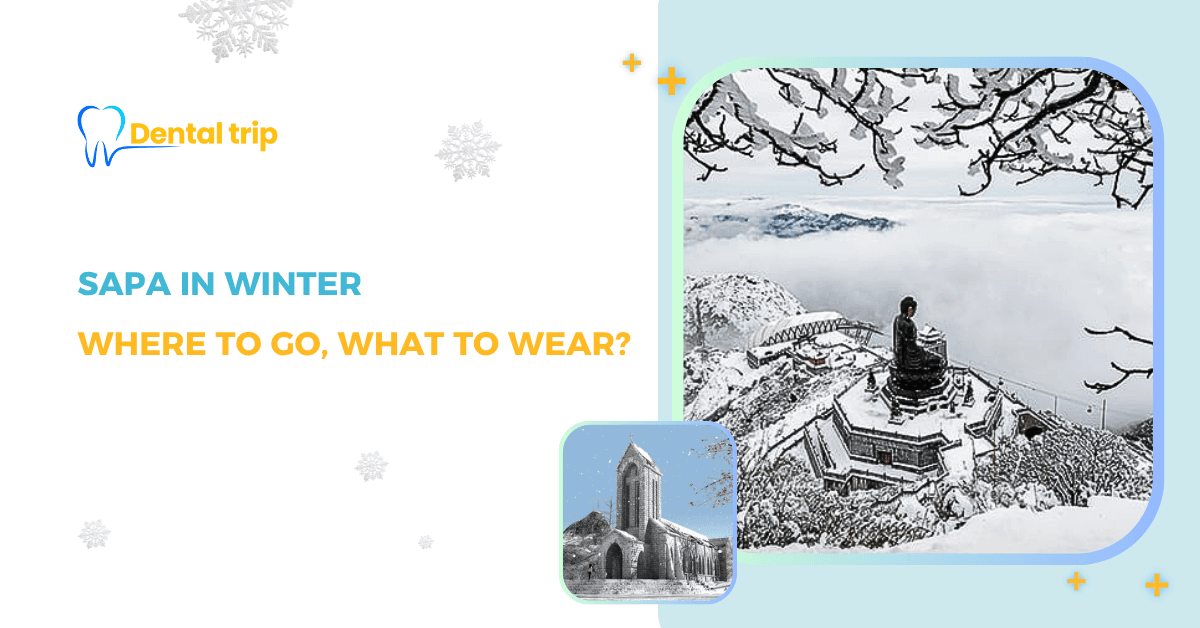
Sapa in Winter: Complete Travel Guide - Photo: Dental Trip
Sa Pa is a popular tourist destination, especially in winter when visitors can admire frost, snow, and many other interesting experiences that are only available in Sa Pa.
If you want to learn about what makes winter tourism in Sa Pa special, where to go, which festivals to join, what delicious dishes to eat, and how to coordinate outfits... you are invited to refer to the information in the article compiled by Dental Trip below.

What is the weather like in Sa Pa during winter?
Due to its high altitude and proximity to the tropics, Sa Pa's climate features characteristics of temperate and humid subtropical climates, with an average annual temperature ranging from 15 to 18 degrees Celsius.
In particular, winter in Sa Pa is shrouded in fog and the temperature is very cold, averaging around 10 degrees Celsius, with frost and snowfall possible during severe weather conditions, with temperatures dropping below 0 degrees Celsius.
However, during the times without monsoon winds, usually around October, the winter climate in Sa Pa is not too cold, with chilly air and warm sunshine in the morning.
Mist appears and the temperature begins to drop below 10 degrees Celsius to 18 degrees Celsius as Sa Pa enters and early December, this is a great time for cloud hunting.
From the second half of December to the end of January, the weather starts to turn cold, with many prolonged cold spells, and the average temperature ranges from 5 degrees Celsius to 10 degrees Celsius, frost and snow will appear when the temperature drops to 1 degree Celsius or below.
The beautiful scenery of Sa Pa in winter
The winter in Sa Pa lasts from October to February of the following year. The weather changes from cool to cold, and the vegetation and nature also change each month, creating a unique landscape at different times, attracting many tourists here.
| Time | Highlight |
| October |
October is the time when Sa Pa enters the ripe rice season, with the golden hues overflowing in the terraced fields. Visiting Sa Pa during this time, enjoying the cool atmosphere under the warm sunshine, and checking in with the ripe rice will be wonderful experiences on your trip. |
| November |
By November, the temperature drops a few degrees Celsius but is still not freezing. The thick fog often envelops the entire town. Buckwheat flowers continue to bloom in Sa Pa until the end of November, alongside the trees of ''táo mèo'' and ''mắc cọp'' (wild pear) laden with fruit. The buckwheat flower fields are immersed in white, mixed with a light pink of the petals, creating a rustic yet breathtaking natural scenery. |
| December |
The cold waves increasingly come as Sa Pa enters December, and there may be frost or the first snow of the season. However, such cold weather creates favorable conditions for many flower species to showcase their beauty, such as Sa Pa ancient roses, sister roses, and Kim Ngu Thao (wolf's mouth)... In the area of the Fansipan Rose Valley around the Muong Hoa Station (the station for the Muong Hoa mountain railway) and the Hoang Lien Station (the station for the cable car to the Fansipan peak), various flowers bloom in competition, attracting many tourists for sight-seeing and check-ins. |
| January and February |
The months of January and February are when spring flowers, or "Tet flowers" such as wild peach blossoms, French peaches, cherry blossoms, apricot flowers, and plum flowers bloom all over the hillsides, halfway up the mountains, the villages of Ta Van and Ta Phin, and the central area of Sa Pa. Hundreds of flowering trees together create a romantic and poetic scene, illuminating a corner of the simple hills. |
Where to go in Sa Pa during winter?
In Sa Pa during winter, tourists have many chill spot choices such as Muong Hoa Valley, Ta Van Village, Sun World Fansipan Legend, O Quy Ho Tea Hill, the Lonely Tree, Fansipan Peak, Ham Rong Mountain, O Quy Ho Pass, and Silver Waterfall to enjoy the cool atmosphere and the beautiful nature of Sa Pa.
Muong Hoa Valley
The Muong Hoa Valley is about 9.3 km southeast of the center of Sa Pa town, and you can travel by motorbike or car, taking about 18 minutes to drive.

Distinctive Winter Beauty of Sa Pa – Experiences to Enjoy at Muong Hoa Valley:
-
Admire the vast, winding terraced rice fields stretching along the mountain slopes — recognized as one of the most beautiful rice terraces in the world.
-
Explore the mysterious ancient stone field featuring nearly 200 enigmatic rocks engraved with undeciphered symbols of unknown origin, scattered across an area of about 8km².
-
Check in at Cau May Bridge, which gracefully spans the winding Muong Hoa Stream like a soft silk ribbon, connecting Ta Van, Lao Chai, Hau Thao, and ending at Ban Ho — stretching nearly 15km.
-
Experience the local culture and savor the specialties of ethnic minorities such as the Red Dao, Giay, Hmong, Tay, and Xa Pho people.
-
Admire the breathtaking beauty and take photos in the plum blossom gardens in full bloom in Ta Van.
-
Join traditional festivals of local ethnic groups, such as the Fire Jumping Festival of the Red Dao and the Roóng Poọc Festival of the Giay people.
Note: The fields are usually harvested, and the Muong Hoa Stream runs dry in winter. To witness the valley’s most stunning scenery, it’s best to visit around October, when the stream still flows and the rice is at its golden peak.
Ta Van Village – The ancient village hidden among the mountains and forests of Sa Pa
Ta Van Village is located in the Muong Hoa Valley, about 9.4 km from the center of Sa Pa, and visitors can travel here by motorbike or car in about 19 minutes.

Ta Van Village is famous for its poetic beauty. If you visit Sa Pa in winter, don’t miss the chance to stop by this charming village and enjoy the following experiences:
-
Feel the year-end chill of a highland village located about 1,500 meters above sea level, and take in the tranquil, dreamy mountain scenery.
-
Admire the white plum blossom gardens blooming across the village from late January to early February, while experiencing the joyful atmosphere of the locals welcoming the Lunar New Year.
-
Immerse yourself in the peaceful, friendly life of the mountain village, learn about the culture of different ethnic groups, and try on traditional costumes of the Hmong and Red Dao people.
-
Check in and experience walking across the ancient Cau May Bridge in Ta Van, made by locals from thin wooden planks tied together with forest rattan ropes to form a walkway over the stream.
-
It’s best to visit Ta Van Village from October, when the terraced rice fields turn golden and the stream still flows gently before the cold winter arrives.
O Quy Ho Tea Hill
O Quy Ho tea hill is 6km from the center of Sa Pa, and it takes about 11 minutes to drive by motorbike or car to get there. However, for convenience in traveling, you should choose a motorbike because the road leading to the tea hill is quite narrow.

With its picturesque natural scenery, visitors will have the following valuable experiences when they come to O Quy Ho Tea Hill during their winter trip to Sapa:
-
Enjoy the fresh, crisp late-year air amidst a vast, lush green natural setting.
-
Admire the romantic view of brilliant cherry blossom (Prunus serrulata) rows that seem to "paint the tea hill pink" during the winter.
-
Take photos and check-in with the endless rolling green tea hills and the vibrant cherry blossoms amidst the immense mountain landscape.
-
Marvel at the stunning, picture-perfect natural landscape, where the vast blue is interspersed with the pink hues of the cherry blossom trees planted amongst the tea plants.
Pro Tip: You should arrive in the early morning, before the sun appears, to have the chance to see the early morning mist swirling around the tea hill and fully savor the cool, fresh air.
Fansipan Peak – Explore the Rooftop of Indochina
From the central square of Sa Pa, you walk about 45 meters to reach Sun Plaza, then buy a ticket and take the Muong Hoa mountain train, continue by cable car to the Sun World Fansipan Legend tourist area.
And either walk or take the Fansipan mountain train to the top of Fansipan – the roof of Indochina, with a total travel time (walking between stations, taking the mountain train, taking the cable car) of about 45 minutes if you go continuously.

At Fansipan Peak, visitors will have the following wonderful experiences:
-
Marvel at the majestic mountain scenery along with the complex of temples, pagodas, and Buddha statues at the Sun World Fansipan Legend Tourist Area.
-
Behold the sea of clouds covering the mountaintop, which is particularly thick and stunning from around November onwards.
-
Witness frost and snowfall on Fansipan Peak, which typically occurs from late December to early February every year.
-
Take check-in photos at the Fansipan Peak marker and flagpole, as well as many other spectacular photo spots.
-
Attend the Winter Festival, usually held in late November or late December, featuring beautiful decorations and captivating performances.
Ham Rong Mountain
Ham Rong Mountain is about 3.2 km from the center of Sa Pa, and you can get there by motorbike or car in just about 8 minutes.

The Ham Rong Mountain Tourist Area is planned and built across an area of 148 hectares, featuring meticulously arranged scenic areas and surrounded by vast coniferous forests. Visitors here will have the following wonderful experiences:
-
Enjoy the cold high-altitude atmosphere at an average elevation of 1,400m to 1,800m above sea level, on one of the most beautiful mountains in the Hoang Lien Son range.
-
Check-in at the central flower garden area, featuring pots of flowers skillfully arranged and cared for by artisans.
-
Visit Thach Lam Rock Garden with massive boulders whose shapes are said to resemble a dragon's claws, scales, and head.
-
You should visit Ham Rong Mountain around late January and February for a chance to see the Japanese cherry blossom garden in vibrant bloom.
-
Take in the panoramic view of Cat Cat Village, Muong Hoa Valley, and Sapa town from above at Heaven's Yard (Sân Thiên đình) or Cloud Yard (Sân Mây), located at the highest point of Ham Rong Mountain.
-
If you want to hunt for clouds, you should visit in November, as the weather is not yet too cold and is ideal for this activity. If you want to see snow, Ham Rong Mountain can also be a suitable spot; the best time to visit is from late January to early February.
O Quy Ho Pass
As one of the four most beautiful mountain passes in Vietnam, located on National Route 4D, 14.8 km from the center of Sa Pa, you can reach the O Quy Ho Pass by car or motorbike in just about 26 minutes.

The mountain pass stretches about 13 km (on the Lao Cai side), featuring many beautiful winding roads surrounded by majestic, poetic mountain scenery. Visiting Ô Quy Hồ Pass in winter, you’ll experience:
-
A thrilling challenge for drivers, as this is one of the highest and most dangerous mountain passes in Vietnam.
-
The serene beauty of twilight descending over the vast mountains and forests, where the last rays of sunlight dance across the stunning terraced fields in a peaceful, quiet atmosphere.
-
Cloud hunting at elevations over 2,000 meters above sea level, where you can watch the floating clouds drift like mist. The best time for this experience is around November.
-
Admiring frost and enjoying the unique cold air of the Northwestern mountains in winter. The ideal time to witness this magical scenery is from January to early February.
Silver Waterfall
Silver Falls is only about 11.9 km from the center of Sa Pa, taking 21 minutes by motorbike or car, and tourists can easily travel here by following National Route 4D, along the road to O Quy Ho Pass.

Silver Waterfall is the source of the Muong Hoa Stream, standing over 200 meters tall and located at the foot of O Quy Ho Pass. The area surrounding the waterfall is blessed with pristine natural scenery — cascading water, lush forests, and majestic mountains.
During your winter trip to Sa Pa, a visit to Silver Waterfall offers not only breathtaking views and refreshing air but also several delightful experiences such as:
-
Taking photos and checking in with friends at the foot of the waterfall or on the bridge spanning across it.
-
Admiring the gentler beauty of Silver Waterfall in winter, when the water flows softly, and feeling the peace as you listen to the sound of falling water.
-
Watching frost and snowfall around Silver Waterfall and O Quy Ho Pass — the best time for this is from late December to early February.
What to wear when traveling to Sapa in winter?
The winter temperature in Sa Pa is around 10 degrees Celsius. If you come to Sa Pa to hunt for snow from late December to early February, the temperature can drop to minus 2 to minus 1 degrees Celsius or lower. You should prepare warm, waterproof clothing and non-slip shoes for a safe and convenient trip.
The winter weather in Sa Pa is freezing, sometimes dropping below zero, so to keep warm and also have beautiful check-in pictures during the trip, travelers can refer to some necessary clothing and ways to coordinate outfits when traveling to Sa Pa in winter below.
You can refer to some necessary clothing in the table below:
| Clothing to Prepare | Tips for Choosing Clothing |
| Thermal pants and tops (inner layer) | Choose body-hugging clothes with comfortable elasticity and soft, smooth fabric to avoid irritation or itching. Pick high-neck tops and pants with ankle cuffs to cover your neck and ankles, keeping out cold air. |
| Sweaters and fleece tops (outer layer) | Feel free to choose any style, but prioritize thick materials with good heat retention. |
| Warm padded jacket | Choose a thick jacket with a zipper for better warmth. High collars that can be pulled up are recommended. Pick materials that are windproof and water-resistant. |
| Pants | Opt for long pants made from thick fabrics such as khaki, jeans, or corduroy. |
| Dresses | You can choose any style that matches your outfit, but it’s better to go with midi or long dresses made from thick materials like khaki, denim, corduroy, or wool. |
| Socks and scarves | Choose thick, high socks. Pick long, wide wool scarves that can be wrapped around your neck and up to your chin to block cold wind. If you wear short skirts, prepare thermal tights to wear underneath. |
| Gloves and hats | Choose wool hats that can cover your ears. Prioritize gloves with cotton lining inside for warmth and water-resistant outer material. |
| Shoes |
Choose shoes with non-slip soles for safety when walking on snow. You can also wear knee-high boots to keep your feet warm. Opt for sneakers or flat shoes rather than high heels (over 5 cm or with pointed heels), as Sapa’s mountainous terrain and slopes can make walking difficult. Make sure the shoes fit snugly to keep your feet warm. |
What to eat in Sa Pa in winter? 6 specialties to try in winter
When you come to Sa Pa in winter, you must try specialties such as sturgeon hotpot, Thang Co, Sa Pa salmon, Vietnam pigs, grilled chicken with green pepper sauce...
The dishes are prepared hot, with fresh ingredients, and seasoned with many kinds of typical spices from the Northwest region, creating a distinct flavor that can only be found in Sa Pa.
Thang Co
The traditional Thang Co pot is made from horse meat, intestines, heart, liver, and blood along with 12 unique spices of the Northeastern people, stir-fried and simmered, then adding vegetables such as kohlrabi stems and mustard greens...
The taste of Thang Co is crispy, sweet, fatty, and very fragrant from the horse meat blended with the spices, dipped in the spicy sauce that warms the body, making it very suitable to enjoy in the winter.

Sa Pa sturgeon hot pot
Sa Pa sturgeon hot pot refers to a hotpot made with sturgeon, a fish prized for its firm texture and rich flavor. This dish is especially popular in the Sa Pa area of Vietnam, known for its cool climate and fertile lands.
The hotpot often includes various vegetables, herbs, and spices, which complement the sturgeon, creating a flavorful, communal dining experience. It's typically enjoyed during colder months, making it a perfect dish for gatherings.

Grilled Chicken with Green Pepper Sauce
The roasted whole/half chicken is wrapped in aluminum foil and grilled hot. The flavor of the chicken meat is tender and chewy, with the skin retaining its crispness, blended with a hint of sweet and sour spices, and a mild spiciness from the green pepper of the Northwest.

Sa Pa salmon
Sa Pa salmon has a fresh pink color, is low in fat, and when eaten, one can feel its tenderness, sweetness, and rich flavor without being mushy while still maintaining its firmness.

Winter Travel Tips for Sapa You Should Know
To ensure a smooth, safe, and healthy winter trip to Sapa, remember to choose safe transportation, bring heat patches, research accommodation and entertainment options in advance, and apply moisturizer and sunscreen before going outside.
Choose safe transportation
During winter, Sapa’s cold weather and thick fog can reduce visibility, making it harder to navigate and travel safely.
If you plan to visit remote locations or travel through dangerous mountain passes such as the Lonely Tree area or O Quy Ho Pass and you’re not confident in your driving skills, consider hiring a motorbike taxi, taking a cab, or asking local residents who are familiar with the terrain and experienced in guiding tourists. This will save time and ensure your safety on the road.
If you want to conquer and admire the snow on the top of Fansipan, you should prioritize taking the cable car of Sun World to save time and effort so that you can enjoy the snow, admire the scenery, take photos, and pay homage to the spiritual sites in the area at the top of Fansipan.
Especially when it snows, the mountain climbing path becomes slippery and very difficult to navigate, making the cable car option much safer.
Note to bring a heat pack
A heat pack is an effective tool to help you instantly stay warm in the cold weather of Sa Pa in winter. Especially for female travelers who want to wear short dresses or thin outfits to take better pictures, the heat pack will keep you warm efficiently.
Note: To achieve the best warmth retention, you should stick the heat-retaining patch on areas such as the chest, lower back, shoulders... and stick it outside the innermost layer of clothing (the thermal layer that fits tightly to the body), and do not stick it directly on the skin.
Refer to entertainment and accommodation services in advance
Winter is the tourist season in Sa Pa, and during this time, there are also many holidays, so many visitors come here. The prices for transportation, entertainment, and accommodation increase significantly and fill up quickly.
Therefore, if you plan to travel to Sa Pa in winter, you should book bus tickets, hotels, etc. at least 2 weeks to 1 month in advance to find satisfactory services at better prices.
Apply moisturizer to avoid peeling and dry skin
The winter climate in Sa Pa is cold, with low humidity and dry weather, causing the skin to lose moisture, peel, and crack.
Therefore, you should pay attention to apply moisturizer to your face, neck, body, hands, and feet before going outside, and reapply after washing your hands, taking a shower, or whenever you feel your skin is dry and lacks moisture to best protect your skin.
Apply sunscreen when going outside
Sunlight contains ultraviolet rays such as UVA, UVB, and UVC, especially UVA which makes up about 95%. These rays cause skin aging, leading to the rapid appearance of wrinkles, skin pigmentation, or even skin cancer.
In winter, sunlight is not as harsh as in summer, but the sun's rays still contact and harm the skin. Therefore, don't forget to apply sunscreen before going outside, and it's best to reapply it every 2 to 3 hours for maximum sun protection.
Explore Sapa in Winter with Dental Trip
If you’re planning a winter getaway to Sapa, Dental Trip is more than just a trusted healthcare travel platform — it’s also your gateway to unforgettable travel experiences.
The platform offers a variety of tours and local experience packages in Sapa, from cloud-hunting at O Quy Ho Pass to exploring Silver Waterfall and immersing yourself in the winter charm of ethnic villages.
Whether you want to enjoy Sapa’s breathtaking mountain views, taste its signature hotpot dishes, or simply relax in the cool misty air, Dental Trip makes it easy to plan your journey with just a few clicks.
Visit the Dental Trip website to discover winter tours in Sapa and find exclusive deals designed especially for international travelers.
Above, Dental Trip has shared a detailed review of fun activities, dining, and entertainment experiences in Sapa during the winter season. We hope you’ve found plenty of useful information. Wishing you a joyful trip filled with wonderful memories!
Related Articles
Explore more articles related to this topic.






Browse topics
Explore the main DentalTrip guide categories.