Wisdom tooth removal in Vietnam: Cost, procedure & clinics for international patients
Wisdom tooth removal in Vietnam offers competitive costs for international patients. Learn about safety, procedure, prices, recovery, and dental clinics.
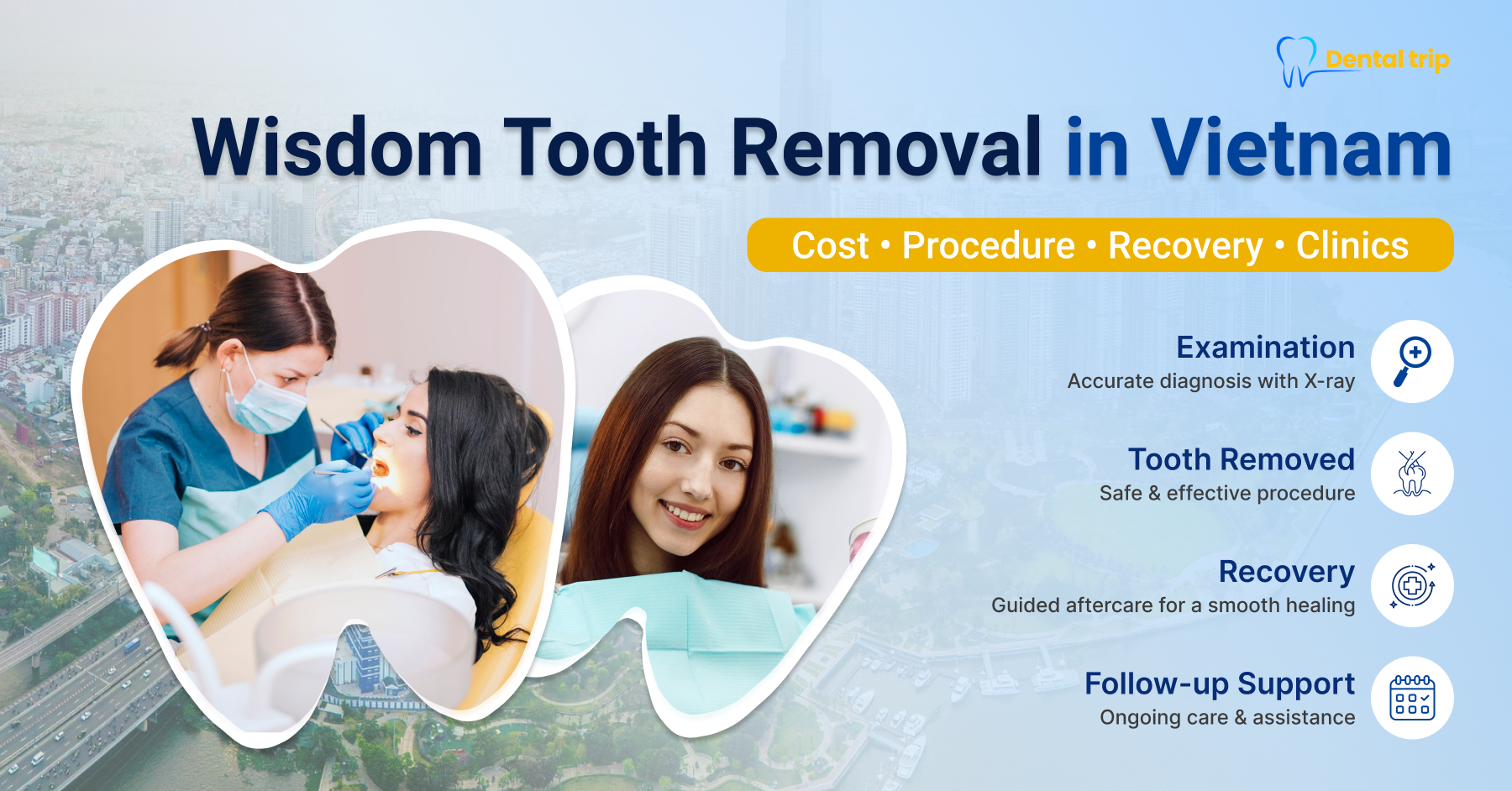
Wisdom tooth removal in Vietnam is safe, modern, and more affordable - Source: dentaltrip.io
Wisdom tooth removal in Vietnam can be performed safely when patients receive a proper examination and diagnosis and are treated by a qualified dental professional at an appropriate dental facility.
With competitive costs and a wide range of dental clinics in major cities, Vietnam is also an option for international patients considering wisdom tooth removal.
Before booking, you should understand the cost, procedure, recovery time, and how to choose a clinic that suits both your dental condition and travel schedule.
Is it safe to get wisdom tooth removal in Vietnam?
Wisdom tooth removal in Vietnam can be performed safely when patients undergo a thorough examination, their dental condition is properly diagnosed, and the procedure is carried out at a qualified dental facility by a dentist with appropriate expertise.
Before wisdom tooth removal, the dentist should assess the patient’s oral health and may recommend an X-ray to evaluate the position of the tooth and surrounding structures.
Establishing a treatment plan before extraction helps the dentist assess the wisdom tooth and minimize the risk of affecting nearby structures, such as blood vessels and nerves.
During the extraction, local anesthesia is commonly used to reduce pain in the treatment area. General anesthesia may be considered in certain cases, such as for patients with severe dental anxiety or for some complex wisdom tooth extractions.
For international patients planning to have wisdom teeth removed in Vietnam, choosing a dental clinic based on price alone is not recommended.
Before booking an appointment, consider the following criteria:
- Dentist performing the procedure: Prioritize a dentist trained in oral and maxillofacial care with experience in wisdom tooth removal, particularly for impacted, angled, or deeply positioned teeth close to a nerve.
- Diagnostic imaging: Check whether the clinic can provide panoramic X-rays (Panorex) or Cone Beam CT (CBCT) when needed to evaluate the tooth position and surrounding anatomical structures.
- Infection control: Ask about instrument sterilization, the procedure area, and the clinic’s infection-control protocols.
- Pain management: Ask in advance about local anesthesia and other appropriate pain-management options based on your condition and the complexity of the extraction.
- Cost: Request a quotation beforehand and check what is included, such as the consultation, diagnostic imaging, procedure, medications, and follow-up visits.
- Post-extraction care: Confirm the aftercare instructions, follow-up schedule, and how to contact the clinic if you experience pain, swelling, bleeding, or other unusual symptoms.
- Support for international patients: If needed, confirm whether English-speaking support is available and inform the dentist of your departure date from Vietnam so that an appropriate follow-up plan can be arranged.

Wisdom tooth removal procedure in Vietnam
The specific wisdom tooth removal procedure may be adjusted by the dentist depending on the tooth’s position, whether it is angled or impacted, the complexity of the case, and the patient’s overall health.
The main steps generally include:
1. Examination and consultation
Before wisdom tooth removal, the dentist will perform a comprehensive oral examination, focusing on the position, eruption angle, and complexity of the wisdom tooth.
- Oral examination: The dentist examines the wisdom tooth and surrounding tissues to make an initial assessment of the condition and determine the appropriate treatment approach.
- X-ray or Cone Beam CT: A panoramic X-ray (Panorex) or Cone Beam CT (CBCT) may be used to accurately determine the position of the wisdom tooth and its relationship with nearby nerves and other important anatomical structures. These images help the dentist plan the extraction and reduce potential risks during the procedure.
- Pre-procedure consultation: After reviewing the examination and imaging results, the dentist will explain the condition of the tooth, why extraction may be necessary, how the procedure will be performed, potential risks, and the appropriate anesthesia options. Patients can also discuss any questions or concerns before deciding to proceed.
2. Preparation before wisdom tooth removal
Before the procedure, patients should prepare their oral hygiene and discuss the appropriate pain-control method with the dentist.
- Oral hygiene: Patients are advised to clean their teeth and mouth before the procedure to help reduce the risk of infection.
- Local or general anesthesia: Local anesthesia is commonly used so that patients do not feel pain during the extraction. For complex cases, patients with severe anxiety, or certain health conditions requiring special consideration, the dentist may recommend general anesthesia.
- Mental preparation: Before the procedure, the dental team will explain the steps involved and answer questions so that patients understand what to expect and feel more comfortable about the treatment.
3. Wisdom tooth removal
The extraction technique will depend on the position and complexity of the tooth. For impacted or difficult wisdom teeth, additional surgical steps may be required to access and remove the tooth safely.
- Incision and bone removal if necessary: The dentist makes an incision in the gum to access the tooth. If the tooth is fully impacted or covered by bone, a small amount of bone may need to be removed to create access.
- Tooth sectioning if necessary: For teeth with complex anatomy or deep impaction, the dentist may divide the tooth into smaller sections before removing it. This can make removal easier and reduce the force applied to surrounding tissues.
- Tooth removal and cleaning: After the wisdom tooth is removed, the extraction site is cleaned to remove any remaining bone fragments or infected tissue, if present.
- Sutures: The extraction site may be closed with dissolvable sutures or sutures that need to be removed after approximately one week, depending on the case. Sutures can help support bleeding control and wound healing.
4. Aftercare and recovery
Proper aftercare following wisdom tooth removal plays an important role in healing and reducing the risk of complications.
- Bleeding control: Patients are usually instructed to bite down on sterile gauze for approximately 30 minutes after the extraction.
- Pain and swelling management: Pain medication should be taken as prescribed by the dentist. A cold compress can be applied to the outside of the cheek during the first 24 - 48 hours to help reduce swelling.
- Diet: During the first few days, choose soft, liquid, and cool foods. Avoid hard, chewy, spicy, or hot foods, as well as alcoholic beverages.
- Oral hygiene: Clean carefully around the extraction site. During the first 24 hours, avoid vigorous rinsing and drinking through a straw to reduce the risk of disturbing the blood clot. From the second day, patients may gently rinse with warm saline solution as instructed.
- Rest: Avoid strenuous physical activity during the first few days after the extraction.
- Follow-up: Patients should attend scheduled follow-up appointments so the dentist can monitor healing and remove sutures if non-dissolvable stitches were used.

How much does wisdom tooth removal cost in Vietnam?
According to pricing data compiled and updated by Dental Trip, the estimated cost based on extraction complexity is as follows:
|
Wisdom tooth condition |
Estimated cost (VND) |
Estimated cost (USD) |
|
Straight wisdom tooth |
500,000 - 1,500,000 VND/tooth |
~19 - 57 USD/tooth |
|
Level 1 angled wisdom tooth |
1,500,000 - 2,000,000 VND/tooth |
~57 - 76 USD/tooth |
|
Level 2 angled wisdom tooth |
2,000,000 - 3,000,000 VND/tooth |
~76 - 115 USD/tooth |
Wisdom tooth removal in Vietnam generally costs around 500,000 - 3,000,000 VND per tooth, depending on the tooth’s position, eruption angle, complexity, and the extraction method used.
For more complex cases, the cost may be higher. For example, some dental clinics charge up to 5,000,000 VND per tooth for difficult or highly complex extractions, while others may charge an additional fee when technologies such as Piezotome ultrasonic surgery are used.
The main factors affecting the cost of wisdom tooth removal include:
- Complexity of the tooth: A fully erupted, angled, impacted, or bone-covered wisdom tooth may require different extraction techniques.
- Position and root anatomy: Teeth that are difficult to access or have complex root structures may make the procedure more challenging.
- Diagnostic imaging: A panoramic X-ray or Cone Beam CT (CBCT) may be required to evaluate the tooth’s position and surrounding anatomical structures before extraction.
- Local or general anesthesia: Local anesthesia is commonly used for wisdom tooth removal. If additional pain-management methods or general anesthesia are required, the total cost may change.
- Treatment facility: Prices and the services included in the quoted fee can vary between hospitals and dental clinics.
Clinics for wisdom tooth removal in Vietnam
|
Dental clinic |
Address |
Opening hours |
Wisdom tooth removal cost (VND/tooth) |
Estimated cost (USD/tooth) |
|
08:00 - 22:00 |
Approx. 2,000,000 - 7,000,000 VND depending on tooth position and complexity |
~76 - 267 USD | |
|
Hanoi:
|
08:00 - 20:00 |
1,500,000 - 5,000,000 VND |
~57 - 191 USD | |
|
92 Nguyen Chanh, Hanoi |
Mon, Wed–Fri: 08:30–19:00Tue: ClosedSat–Sun: 08:00–18:30 |
1,500,000 - 5,000,000 VND |
~57 - 191 USD | |
|
25H Nguyen Binh Khiem, Ben Nghe, Ho Chi Minh City |
08:00 - 12:00; 14:00 - 19:00 |
1,000,000 - 5,000,000 VND |
~38 - 191 USD | |
|
119 Yersin, Ben Thanh & 378B Vo Van Tan, Ban Co, Ho Chi Minh City |
Mon - Sat: 08:00 - 18:00 Sun: 08:00 - 16:00 |
3,000,000 - 8,000,000 VND |
~115 - 305 USD | |
|
1111 Luy Ban Bich, Tan Son Nhi, Ho Chi Minh City |
Mon - Sat: 08:00 - 19:30 Sun: 08:00 - 19:00 |
1,000,000 - 3,000,000 VND |
~38 - 115 USD |
Recovery after wisdom tooth removal
Proper aftercare during the first few days after wisdom tooth removal plays an important role in controlling bleeding, reducing pain and swelling, and supporting the healing process.
Patients should follow their dentist’s instructions carefully, particularly during the first 24 hours after the procedure.
- During the first 6 hours: Avoid disturbing the extraction site. Do not rinse your mouth, allowing the extraction socket time to stabilize. After this period, if necessary, you may rinse your mouth gently with water.
- During the first 24 hours: Bite down on gauze for approximately 30–45 minutes after the extraction to help control bleeding. Avoid spitting or vigorous rinsing, as this may interfere with blood clot formation. A cold compress can be applied to the outside of the cheek near the extraction site to help reduce pain and swelling.
- After 24 hours: You can begin brushing your teeth with a soft-bristled toothbrush, while avoiding direct contact with the extraction site. A warm compress may be used to help relieve tenderness, bruising, and swelling.
- Over the next few days: Continue taking medications as prescribed by your dentist and maintain a soft, easy-to-chew diet. The level of pain and swelling can vary from person to person, so continue monitoring the extraction site throughout the recovery period.
During recovery, keep the following points in mind:
- Protect the blood clot: During the first 24 hours, avoid vigorous rinsing and spitting.
- Manage pain and swelling: Apply a cold compress to the cheek during the first 24 hours. After 24 hours, you may switch to a warm compress as instructed.
- Take medications as prescribed: Follow your dentist’s instructions for medications used to manage pain, swelling, and other post-extraction symptoms.
- Maintain gentle oral hygiene: Do not rinse your mouth during the first 6 hours. After the first day, you can brush with a soft-bristled toothbrush while avoiding the extraction site.
- Watch for unusual symptoms: If you experience severe pain, persistent swelling, or heavy bleeding that cannot be controlled, contact or visit your dentist for evaluation.
During the first few days after wisdom tooth removal, choose soft, easy-to-swallow foods that require minimal chewing to avoid irritating the healing extraction site.
|
Foods to eat |
Foods to avoid |
|
Porridge |
Hard foods |
|
Soft noodles |
Crunchy foods |
|
Soft, easy-to-swallow foods |
Chewy foods that require extensive chewing |
|
Fruit juice |
Spicy or hot foods |
|
Foods rich in vitamin C |
Alcoholic beverages |
There is no need to follow an overly restrictive diet. However, during the first few days, it is best to choose foods that require minimal chewing and avoid anything that may irritate the extraction site.
As healing progresses, patients can gradually return to their normal diet based on their recovery and their dentist’s specific instructions.

What support is included for international patients?
For international patients, Dental Trip helps simplify the process of finding and booking dental care in Vietnam, particularly if you are unfamiliar with local clinics or have a limited amount of time available for treatment.
Based on your dental condition, accommodation location, and travel schedule, Dental Trip can help you find a suitable clinic, check appointment availability, and connect with the clinic to arrange your visit.
Before your appointment, you can also receive essential information such as the clinic address, appointment time, and what you should prepare in advance.
If your travel plans change, Dental Trip can help communicate with the clinic and adjust your appointment when needed.
For patients who experience language barriers, Dental Trip can also assist with communication and appointment-related information, making it easier to connect with the clinic.
If your trip is time-sensitive, share your expected arrival and departure dates in Vietnam. Dental Trip will take your schedule into account when searching for and connecting you with a suitable dental clinic.
Wisdom tooth removal in Vietnam can be a suitable option for international patients when the procedure is performed at a reputable dental facility with appropriate examination and diagnostic procedures, a qualified dentist, and a clear post-extraction care plan.
Costs can vary considerably depending on the tooth’s position, eruption angle, and complexity, so listed prices should only be used as a reference before an in-person examination.
If you are planning to have a wisdom tooth removed while traveling in Vietnam, allow enough time for the examination, procedure, and initial recovery.
You should also inform the clinic of your expected departure date from Vietnam so that follow-up care can be planned accordingly. Following your dentist’s aftercare instructions is also important for a smooth recovery.
If you are unsure which clinic to choose, Dental Trip can help you find and connect with a suitable dental clinic based on your location, treatment needs, and travel schedule, as well as assist with appointment arrangements to make accessing dental care in Vietnam more convenient.
FAQ
Common questions international patients ask before booking.
Related Articles
Explore more articles related to this topic.


Browse topics
Explore the main DentalTrip guide categories.