Travel Insurance for Dental Treatment in Vietnam: What Is Actually Covered?
Meta description: Does travel insurance cover dental treatment in Vietnam? Learn what may be covered for emergency dental care, implants, veneers, complications, medical evacuation and claims.
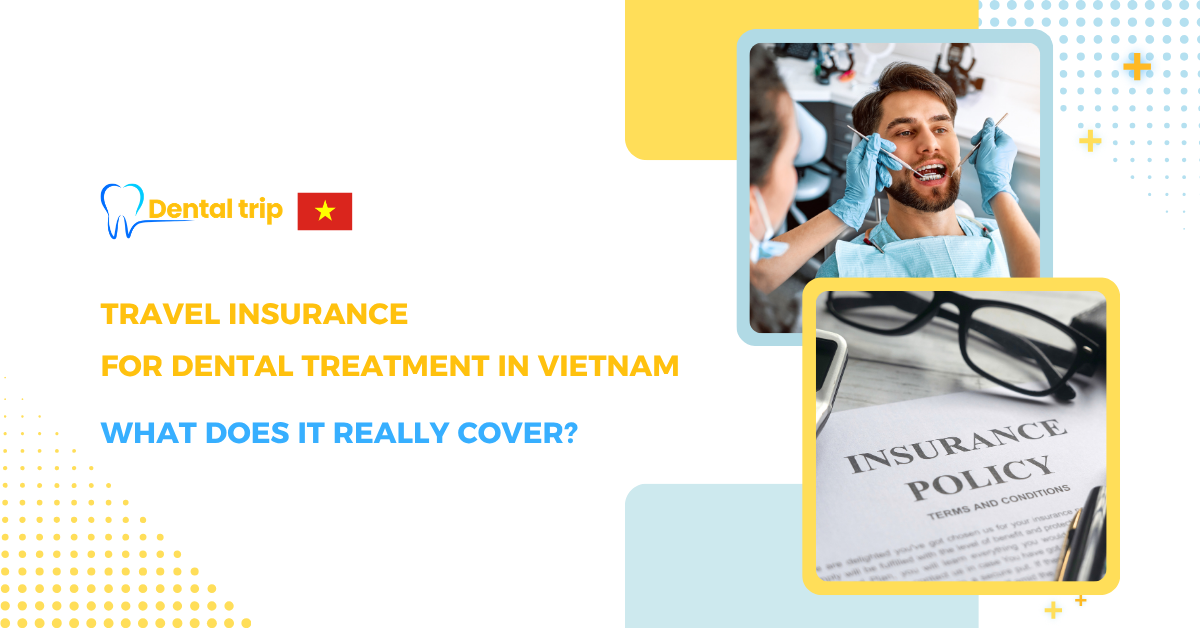
Travel Insurance for Dental Treatment in Vietnam - Photo: Dental Trip
Travel insurance can be useful when travelling to Vietnam for dental treatment, but it does not necessarily cover the dental procedure you have planned.
Standard travel insurance commonly distinguishes between emergency dental treatment and elective or planned dental treatment such as implants, veneers, crowns and All-on-4.
Before travelling, patients should understand the exclusions, coverage limits, complication rules, medical evacuation benefits and documents required to make a claim.
If you are travelling to Vietnam specifically for dental treatment, the most important question is not simply “Do I have travel insurance?” It is “What exactly does my policy cover if something happens during or after my dental treatment?”
Does Travel Insurance Cover Dental Treatment in Vietnam?
Usually, standard travel insurance does not cover planned dental treatment such as dental implants, veneers, crowns or All-on-4 simply because you are travelling overseas.
However, some travel insurance policies provide limited cover for unexpected emergency dental treatment, subject to specific conditions, exclusions and benefit limits.
This distinction is particularly important for dental tourists.
A person travelling from Australia, the UK, New Zealand, the US or another country to Vietnam for a planned dental procedure is undertaking what insurers and government travel authorities generally regard as medical tourism or overseas elective treatment.
Australia's Smartraveller currently warns that basic travel insurance generally does not cover medical tourism.
Its August 2026 guidance specifically states that standard policies usually exclude elective procedures and problems arising from them, and advises travellers to check whether their policy covers the procedure, complications and medical evacuation.
This does not mean travel insurance is useless for a dental trip. It may still provide protection for other unexpected events during your journey, depending on the policy, such as unrelated illness, accidents, hospital treatment, trip disruption or emergency evacuation.
The key is to separate three different situations:
| Situation | How it is generally treated |
|---|---|
| Planned dental treatment in Vietnam | Usually not covered by standard emergency dental benefits |
| Unexpected dental emergency during the trip | May be covered, depending on the policy |
| Complication following planned dental treatment | Highly policy-dependent and may be excluded |
Insurance terms vary significantly between providers. Always check the current Product Disclosure Statement (PDS) or equivalent policy wording before relying on coverage.
What Is the Difference Between Emergency and Planned Dental Treatment?
The phrase “dental cover” can be misleading because a policy may provide dental benefits only for specific emergencies.
For example, current Australian policies illustrate how narrow this benefit can be.
Nib's travel insurance information says its emergency dental benefit may cover urgent overseas treatment to relieve sudden and acute pain, but specifically excludes routine, cosmetic and major dental work, including veneers, crowns, implants and bridges.
Cover-More similarly states that its international policies can provide emergency dental cover, but excludes routine dental treatment, whitening and cosmetic dentistry. Its current listed maximum for overseas emergency dental is A$2,000 on the policies shown.
A current 1Cover PDS provides another useful example. It lists a A$2,000 dental benefit, but defines covered dental treatment as emergency treatment certified by a dentist as necessary to relieve sudden and acute pain to sound and natural teeth.
It excludes cosmetic dentistry, deterioration or decay-related treatment and several other dental situations.
Therefore, having a policy with a line called “Dental Expenses” does not necessarily mean that your planned dental treatment in Vietnam is insured.
Examples of emergency dental situations
Depending on the policy, an unexpected problem such as:
- Sudden severe tooth pain
- Accidental damage to a natural tooth
- A dental injury during the trip
- Another acute dental problem requiring urgent treatment
may qualify for emergency dental cover.
Examples of planned dental treatment
These are generally different:
- Dental implants
- All-on-4
- All-on-6
- Veneers
- Crowns
- Bridges
- Dentures
- Smile makeovers
- Teeth whitening
- Full-mouth rehabilitation
These procedures are normally planned before the trip and are therefore not the same as an unexpected dental emergency.
Does Travel Insurance Cover Dental Implants, All-on-4 or Veneers in Vietnam?
In most standard travel insurance policies, you should not assume that it does.
This is one of the most important points for dental tourists to understand.
Dental implants
A dental implant is normally planned in advance and may involve consultation, CBCT imaging, implant placement, healing and subsequent restoration.
That makes it fundamentally different from receiving emergency treatment for sudden tooth pain while on holiday.
For example, nib's current travel insurance information specifically lists implants among major dental work that its emergency dental benefit does not cover.
All-on-4 and All-on-6
Full-arch procedures such as All-on-4 and All-on-6 are also planned major dental treatments.
Patients should not assume that a travel insurance policy's medical or dental section will pay for:
- Implant surgery
- Temporary teeth
- Permanent prostheses
- Bone grafting
- Sinus lifting
- Laboratory fees
- Final full-arch restorations
Unless the policy specifically provides such coverage.
Veneers
Veneers are generally considered elective or cosmetic dental treatment rather than emergency dental treatment.
Current travel insurance examples from nib and Cover-More specifically exclude cosmetic dental procedures such as veneers or whitening from their emergency dental benefits.
Crowns and bridges
Crowns and bridges can be medically necessary in some circumstances, but a crown or bridge that you travel overseas specifically to receive is still planned treatment.
The exact insurance treatment depends on the policy wording. Some policies explicitly exclude major dental work or treatment related to existing deterioration or decay.
The practical rule is simple:
Do not book a dental procedure in Vietnam assuming your ordinary travel insurance will reimburse the treatment. Confirm it with the insurer first.
What If You Develop a Complication After Dental Treatment in Vietnam?
This is arguably the most important insurance question for dental tourists.
Imagine this situation:
Australia → Vietnam → implant surgery → complication → additional treatment in Vietnam → return to Australia.
The fact that you have travel insurance does not automatically mean that all costs resulting from the complication are covered.
Current Australian government guidance specifically warns medical tourists to check whether their insurance covers elective procedures, complications and medical evacuation after a planned procedure.
Some policy wordings go further and specifically exclude complications arising from elective treatment.
For example, the March 2026 1Cover PDS excludes complications from dental, medical or surgical procedures that were not themselves for an illness or injury otherwise covered by the policy. It also contains an exclusion for elective surgery or treatment.
This means a patient should investigate the following before travelling:
- What happens if the implant becomes infected?
- What happens if additional surgery is required?
- Is treatment for a post-operative complication covered?
- Is emergency hospital treatment covered?
- Is treatment required after returning home covered?
- Does the insurer need to approve treatment first?
- Is medical evacuation covered?
- Are there maximum benefit limits?
- Does the exclusion section mention elective procedures or complications?
There is no single answer that applies to every insurer.
Why this matters for dental tourism
A complication may appear days or weeks after the original procedure. For example:
- Infection
- Prolonged swelling
- Bleeding
- Implant-related problems
- Wound complications
- Prosthetic problems
- Unexpected pain
- The need for additional treatment
Some complications may be managed by the original clinic in Vietnam. Others may become apparent only after the patient has returned home.
The CDC's 2026 Yellow Book recommends that medical tourists discuss how treatment-related complications will be handled before travelling, understand their insurance coverage and arrange appropriate follow-up care. It also recommends keeping copies of overseas medical records in English.
Can Pre-Existing Dental Problems Affect Travel Insurance?
Yes.
A pre-existing condition is particularly important when travelling for dental treatment because many dental tourists already know that they have dental problems before purchasing insurance.
For example, a traveller may already have:
- Missing teeth
- Severe tooth decay
- Periodontal disease
- An existing infection
- A failed dental implant
- A broken crown
- A tooth that needs extraction
- Ongoing dental pain
If the condition existed before the journey, it should not automatically be treated as a new emergency simply because the patient experiences symptoms while in Vietnam.
Australian government financial guidance advises travellers to check how pre-existing medical conditions affect their policy. Depending on the insurer, a condition may be covered, covered for an additional premium, or excluded.
The Australian Dental Association also advises travellers not to leave Australia with an existing dental problem and recommends a dental examination well before departure. It notes that overseas treatment costs, particularly for pre-existing conditions, may not be covered by travel or private health insurance.
If you already know that you need dental treatment, tell the insurer what is relevant when applying and ask how the planned treatment affects your coverage.
What Should You Check in Your Travel Insurance Policy Before Going to Vietnam?
Do not rely only on the insurance product's marketing page.
Read the PDS, policy wording or equivalent document and look specifically for these terms:
| What to Check | What to Look For |
|---|---|
| 1. Emergency dental | Find out exactly what the insurer defines as a dental emergency. Check whether sudden pain, dental trauma or temporary/emergency treatment is covered. |
| 2. Elective treatment | Check whether elective medical or dental procedures are excluded from the policy. |
| 3. Cosmetic treatment | Check exclusions for cosmetic procedures, particularly if you are planning veneers, whitening or other aesthetic dental treatments. |
| 4. Pre-existing conditions | Check whether existing dental problems must be declared and whether they affect your eligibility for cover. |
| 5. Complications | Look specifically for exclusions involving complications arising from elective or planned dental procedures. |
| 6. Medical expenses | Understand what happens if you require hospital or medical care unrelated to your planned dental treatment. |
| 7. Medical evacuation & repatriation | Check whether medically necessary evacuation or repatriation is covered and who is responsible for arranging it. |
| 8. Benefit limits | Check the maximum amount payable for dental treatment. Some policies may have relatively small dental sub-limits. For example, current Australian policies from nib, Cover-More and 1Cover show dental sub-limits around A$1,000–A$2,000, depending on the policy and circumstances. These are examples, not a universal industry limit. |
| 9. Pre-authorisation | Check whether you must contact the insurer's emergency assistance team before receiving certain types of treatment. |
| 10. Treatment after returning home | For dental tourism, check whether the policy covers complications or follow-up treatment required after you return to |
Questions to Ask Your Travel Insurer Before Dental Treatment in Vietnam
If you are unsure about your policy, contacting the insurer directly is often more useful than trying to interpret a general marketing page.
You can ask:
“I am travelling to Vietnam specifically for planned dental treatment. Does this affect my travel insurance?”
Then ask:
- Does my policy cover emergency dental treatment in Vietnam?
- What is the maximum amount I can claim for emergency dental treatment?
- Does the policy cover accidental dental injuries?
- Are implants excluded?
- Are crowns or bridges excluded?
- Are veneers or cosmetic procedures excluded?
- Are complications from elective dental treatment excluded?
- If I develop an infection after dental surgery, what cover applies?
- Does the policy cover emergency hospital treatment related to a dental complication?
- Is medical evacuation covered if I become seriously ill?
- Do I need to contact the insurer before receiving treatment?
- Can I claim if I have to pay the dentist upfront?
- What documents do I need for a dental claim?
- Does coverage continue after I return home?
- Are my existing dental conditions considered pre-existing conditions?
Keep the insurer's answer in writing if possible.
Will You Need to Pay the Dentist First?
Possibly.
Do not assume that an overseas dental clinic will bill your insurer directly.
The CDC advises international travellers to check whether their insurer reimburses out-of-pocket payments made to healthcare providers abroad.
It notes that in many cases, healthcare providers outside the traveller's home country do not accept direct payment from the insurer, meaning the traveller may need to pay upfront and submit the receipts later.
For a dental tourist in Vietnam, this means you should have access to a suitable payment method and enough emergency funds even if you have insurance.
If you receive emergency dental treatment, ask the clinic for:
- An itemised invoice
- Payment receipt
- Dentist's written report
- Diagnosis
- X-rays
- Treatment details
- Prescription, if applicable
Some insurers specifically require written confirmation from the treating dentist.
For example, nib says emergency dental claims require a written note from the treating dentist confirming that treatment was necessary.
What Dental Documents Should You Keep After Treatment in Vietnam?
Good documentation is important even if you never make an insurance claim.
For planned dental treatment, consider keeping:
- Treatment plan
- Itemised quotation
- Final invoice
- Payment receipts
- X-rays
- CBCT scans
- Dentist's clinical notes
- Prescriptions
- Implant brand and model
- Implant-related documentation
- Crown or veneer material information
- Laboratory information where available
- Post-treatment instructions
- Follow-up recommendations
For implant patients, it is particularly useful to keep the implant system, model and relevant treatment records.
The reason is simple: if you later need treatment in your home country, your local dentist will have more information about what was done in Vietnam.
The CDC recommends medical tourists obtain copies of overseas medical records in English and provide them to healthcare professionals involved in subsequent care.
The Australian Dental Association similarly recommends requesting a written report and radiographs after emergency dental treatment overseas so they can be given to the patient's regular dentist after returning home.
What Happens If You Need Dental Treatment After Returning Home?
This is something to discuss with your Vietnamese clinic before treatment, especially for major procedures such as implants and full-mouth rehabilitation.
Ask:
- Who should I contact if I have a problem after returning home?
- How long does the clinic provide follow-up support?
- What happens if I need an adjustment?
- What happens if I need additional treatment?
- Does the clinic require me to return to Vietnam?
- What documents will I receive before leaving?
- Can my local dentist communicate with the Vietnamese dentist if necessary?
The CDC highlights continuity of care as an important consideration in medical tourism. Patients should have a plan for follow-up care before travelling and understand how complications will be managed after returning home.
This is particularly relevant for treatments that require multiple stages.
For example, an implant treatment may involve:
Consultation → Imaging → Implant placement → Healing → Abutment/prosthetic stage → Final restoration.
The patient's travel schedule should therefore be planned around the clinical treatment timeline rather than treating the procedure as a normal holiday appointment.
Travel Insurance vs Dental Insurance vs Private Health Insurance
These forms of insurance should not be treated as interchangeable.
| Type of insurance | Main purpose | Relevance to dental tourism |
|---|---|---|
| Travel insurance | Unexpected problems while travelling | May cover certain emergencies, illness, accidents, evacuation and travel disruption |
| Dental insurance | Dental treatment benefits | Coverage for overseas treatment varies significantly |
| Private health insurance | Healthcare expenses under the policy | Overseas treatment may be limited or excluded |
| Medical evacuation insurance | Transport during a serious medical emergency | Particularly relevant when travelling abroad for major treatment |
The CDC explains that travel disruption insurance, travel health insurance and medical evacuation insurance can provide different forms of protection. Travellers should check their existing health insurance and consider whether additional coverage is needed for their circumstances.
Therefore, having private dental insurance at home does not automatically mean that planned dental treatment in Vietnam will be reimbursed.
Likewise, buying travel insurance does not automatically insure your dental procedure.
Do You Need Travel Insurance If You Are Going to Vietnam Mainly for Dental Treatment?
Travel insurance may still be useful even when your planned dental treatment itself is excluded.
Your trip involves more than the dental procedure.
You may still need protection against:
- Unexpected illness
- Accidents
- Hospitalisation
- Trip interruption
- Cancellation, where covered
- Baggage problems
- Emergency medical transport
- Repatriation
The exact benefits depend on the policy.
For travellers going to Vietnam, the UK government's current health guidance recommends appropriate travel insurance for local treatment and unexpected medical evacuation. It specifically advises checking cover for existing conditions, medical expenses, air ambulance and repatriation.
For Australians, Smartraveller similarly recommends reading the PDS carefully and checking exclusions, inclusions and definitions before purchasing travel insurance.
So the better question is not:
“Does travel insurance cover my dental treatment?”
Instead ask:
“What risks during my dental trip are covered by my policy, and what risks remain my responsibility?”
Three Common Dental Tourism Insurance Scenarios
Understanding real-life scenarios can make the difference between having insurance and actually understanding your protection.
Scenario 1: Planned All-on-4 treatment
A patient travels from Australia to Ho Chi Minh City specifically for All-on-4 treatment.
The implant surgery and prosthetic treatment were arranged before departure.
Likely insurance position: Standard emergency dental cover should not be assumed to pay for the planned procedure.
Scenario 2: Sudden dental emergency during the trip
A traveller is in Vietnam for a holiday and suddenly suffers severe tooth pain.
They visit a qualified dentist for emergency treatment.
Likely insurance position: The policy may provide emergency dental cover if the event meets the policy definition and all conditions are satisfied.
Scenario 3: Complication following planned treatment
A patient travels to Vietnam for implant surgery and later develops a complication.
Likely insurance position: This requires careful review of the policy. Some policies specifically exclude complications arising from elective treatment.
These examples show why simply purchasing a policy with a “dental” benefit is not enough.
How to Reduce Financial Risk When Getting Dental Treatment in Vietnam
Travel insurance is only one part of preparing for dental tourism.
Before travelling, consider these steps.
1. Get a clear treatment plan
Ask the clinic to explain the proposed treatment, number of visits and treatment stages.
2. Request an itemised quotation
Make sure you understand what is included and what may cost extra.
3. Ask about possible changes
For complex cases, the final treatment may depend on an examination and imaging in Vietnam.
4. Discuss complications and follow-up
Ask what happens if healing does not progress as expected.
5. Check your insurance independently
Do not rely on the clinic's interpretation of your insurance policy.
6. Keep emergency funds available
Insurance claims can take time and may not cover every expense.
7. Keep all dental records
Take your records home with you.
8. Have a plan for follow-up care
Know where you could seek treatment after returning home if necessary.
9. Avoid booking an unrealistically short trip
Major dental procedures may require follow-up appointments or recovery time.
10. Do not choose a clinic solely because treatment is cheaper
The Australian government's current medical tourism guidance recommends researching the healthcare system, provider credentials, clinic reputation, legal rights and follow-up arrangements before committing to overseas treatment.
What Australian Patients Should Know About Dental Treatment in Vietnam
For Australians, travel insurance deserves particular attention because the Australian government has recently published specific guidance about medical tourism.
Smartraveller's August 2026 advice specifically includes overseas dental treatment within medical tourism and warns that standard travel insurance generally does not cover elective procedures or complications arising from them. It recommends confirming coverage for the procedure, complications and medical evacuation before travelling.
The Australian Dental Association also advises travellers to address existing dental problems before departure and to make sure they have adequate insurance for emergency dental treatment overseas.
At the same time, real-world discussions show why dental tourism remains attractive to some Australians. Recent Reddit discussions include Australians researching crowns, veneers and implant treatment in Vietnam because of the cost of dental care at home.
These discussions are individual experiences rather than evidence of insurance coverage, but they illustrate the practical questions prospective patients are asking about cost, clinic selection, communication and treatment logistics.
For Australian patients considering Vietnam, the practical checklist is therefore:
Before booking:
- Check your travel insurance PDS.
- Tell the insurer about relevant pre-existing conditions.
- Ask specifically about elective dental treatment.
- Ask about complications.
- Check medical evacuation and repatriation.
- Ask whether you need pre-authorisation.
- Confirm the claim process.
Before leaving Vietnam:
- Collect your treatment records.
- Get X-rays or CBCT copies where relevant.
- Keep invoices and receipts.
- Record implant and material information.
- Confirm follow-up arrangements.
Final Checklist: Before You Fly to Vietnam for Dental Treatment
If you are planning dental treatment in Vietnam, use this checklist before departure:
Insurance
-
Read the current PDS.
-
Check emergency dental benefits.
-
Check exclusions for elective treatment.
-
Check cosmetic dentistry exclusions.
-
Check pre-existing condition rules.
-
Check complication exclusions.
-
Check medical evacuation and repatriation.
-
Ask whether pre-authorisation is required.
Dental treatment
-
Receive a written treatment plan.
-
Ask for an itemised quotation.
-
Understand how many appointments are required.
-
Discuss possible complications.
-
Understand follow-up arrangements.
Documents
-
Keep your insurance details.
-
Keep your treatment plan.
- Keep invoices and receipts.
- Request copies of X-rays/CBCT.
-
Keep implant and material information.
-
Request relevant clinical records in English where possible.
Most importantly, do not assume that having travel insurance means your planned dental treatment in Vietnam is insured. Travel insurance may protect you against other unexpected events during your trip, while planned dental treatment and complications arising from it may fall outside the policy.
If you are considering dental treatment in Vietnam, understanding the insurance rules before booking your treatment can help you plan your budget, treatment schedule and follow-up care more realistically.
How Dental Trip Can Help You Prepare for Dental Treatment in Vietnam
Dental Trip is a dental information and booking platform that helps international patients explore dental treatment options in Vietnam and arrange consultations with selected clinics.
Before travelling, patients can use Dental Trip to:
- Compare dental clinics based on treatment needs, location and budget.
- Request a free dental consultation before travelling.
- Submit dental photos, X-rays or CBCT scans for a preliminary review where available.
- Discuss a preliminary treatment plan and estimated costs with the clinic.
- Ask about treatment timelines and appointments before planning the trip.
- Book a dental appointment in advance.
- Connect directly with the clinic's dental team for treatment-related questions.
This can be particularly useful for international patients considering procedures that require more planning, such as dental implants, All-on-4, All-on-6, veneers or full-mouth rehabilitation.
Dental Trip does not provide the dental treatment itself. Examination, diagnosis, treatment planning and procedures are performed by the selected dental clinic.
Dental Trip's role is to provide dental information, facilitate booking and help international patients connect with suitable clinics.
Important: Dental Trip does not replace your travel insurance provider. If you are travelling to Vietnam specifically for dental treatment, contact your insurer directly to confirm what your policy covers before your trip.
FAQ
Common questions international patients ask before booking.
Related Articles
Explore more articles related to this topic.

Browse topics
Explore the main DentalTrip guide categories.