
The Dental Implant Process in Vietnam: What Aussies Need to Know
Dental implant treatment in Vietnam typically involves two trips from Australia. The first covers implant placement, followed by a 3 - 6 month healing period before the second trip for permanent teeth.
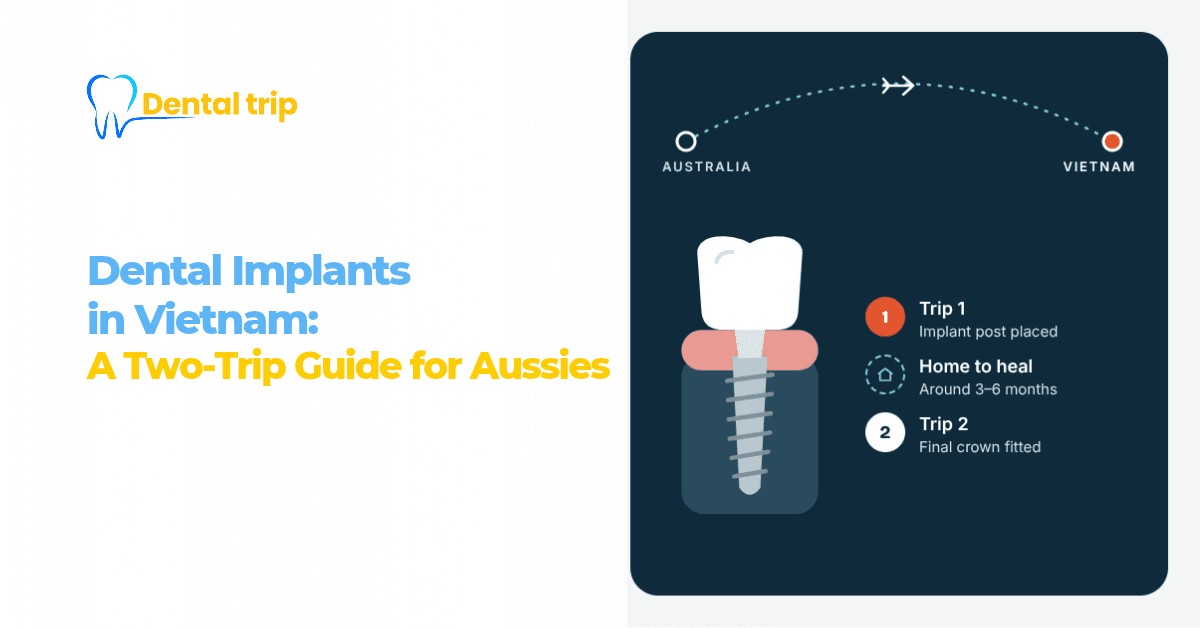
The Dental Implant Process in Vietnam: What Aussies Need to Know - Source: dentaltrip.io
Travelling from Australia to Vietnam for dental implants requires planning around two separate visits and the healing period in between.
For most dental implant treatments, the process takes place over two trips, with approximately 3 - 6 months between visits. The first trip involves dental examinations, implant placement and initial recovery. After returning to Australia, patients allow the implants to integrate with the jawbone before travelling back to Vietnam for their permanent crowns or full-arch teeth.
This guide explains the dental implant process in Vietnam, including how long patients need to stay on each trip and what happens between visits.
Why does dental implant treatment in Vietnam usually require two trips?
Traditional dental implant treatment usually requires two trips because the implant needs time to integrate with the jawbone before the permanent crown or teeth can be attached.
A dental implant is a small titanium fixture surgically placed into the jawbone to replace the root of a missing tooth. After placement, the surrounding bone gradually grows around and bonds with the implant surface. This biological process is known as osseointegration.
The implant must achieve sufficient stability before it can support the final restoration. This is why dentists generally separate implant placement from permanent crown fitting.
The treatment typically involves three stages:
- First trip - Implant placement: The dentist examines your oral health, plans the treatment and places the implant fixtures. Temporary teeth may be provided if clinically appropriate.
- Healing period - 3 - 6 months: You return to Australia while the implants integrate with your jawbone.
- Second trip - Permanent teeth: You travel back to Vietnam for impressions or digital scans, crown fabrication and final fitting.
It is also important to distinguish between temporary and permanent teeth. Temporary teeth may restore your appearance while the implants heal, but they are not the final restoration. Permanent crowns or full-arch teeth are fitted once the dentist confirms that the implants are ready.
What happens during the two trips to Vietnam?
The two trips involve different stages of treatment, with the healing period taking place in Australia. Understanding what happens during each visit can help you arrange flights, accommodation and time away from work.
Trip 1 - Dental examination and implant placement (7 - 14 days)
The first trip generally takes around 7 - 14 days, depending on your oral health, the number of implants and whether additional procedures are required.
For Australian patients, allowing approximately two weeks is recommended to provide enough flexibility for surgery, recovery and follow-up appointments.
1. Initial consultation and treatment planning
Your first appointment involves a comprehensive dental examination to determine whether implant surgery is appropriate.
The dentist may:
- Examine your teeth, gums and overall oral health.
- Take 3D CT scans to assess jawbone volume and structure.
- Check for gum disease, infection or other dental conditions.
- Determine whether tooth extraction, bone grafting or sinus lift procedures are needed.
- Discuss suitable implant systems and restoration options.
- Prepare a treatment plan with estimated costs and an expected timeline.
If you have existing dental records, X-rays or CT scans from Australia, bring them to your consultation. These records can help the dentist understand your dental history, although additional examinations may still be required.
2. Implant surgery
Once the treatment plan is confirmed, the dentist proceeds with implant placement.
During surgery, the dentist prepares the implant sites and inserts the titanium fixtures into the jawbone at the planned positions.
Depending on your condition, additional procedures such as tooth extraction, bone grafting or sinus lift may be performed during the same treatment stage or at a separate appointment.
The number of implants and the complexity of the procedure influence the time required for surgery and recovery.
After the procedure, the dentist provides instructions on managing swelling, maintaining oral hygiene, eating and caring for the surgical areas.
3. Temporary teeth (if clinically suitable)
Some patients may receive temporary teeth within 24 - 48 hours after implant surgery.
However, immediate temporary teeth are not suitable for everyone. The decision depends on several clinical factors, including:
- Initial stability of the implants.
- Jawbone quality and volume.
- Number and position of the implants.
- Whether bone grafting or other additional procedures were performed.
- The patient's overall oral health.
Temporary teeth can help restore appearance and may provide limited chewing function, depending on the restoration and loading protocol.
Patients should follow the dentist's dietary instructions and avoid putting excessive pressure on newly placed implants.
Receiving temporary teeth does not mean the implant treatment is complete. The permanent restoration is generally fitted after sufficient healing.
4. Post-operative examination and recovery
Before returning to Australia, patients should attend the recommended post-operative appointments.
A follow-up examination is often arranged around 7 - 10 days after surgery, depending on the treatment schedule. The dentist checks the surgical sites, monitors healing and removes stitches if necessary.
The dentist will also assess whether you are ready to travel and provide instructions for ongoing care at home.
A stay of at least 7 - 10 days is a practical starting point for many patients. However, allowing approximately two weeks is preferable if your schedule permits, especially if you are receiving multiple implants or additional procedures.
Healing period between the two trips (3 - 6 months)
After completing the first stage, you can return to Australia and continue your recovery at home. The healing period usually lasts around 3 - 6 months, although the exact duration depends on your bone condition, implant stability and treatment complexity.
You do not need to remain in Vietnam during this period.
What happens during implant healing?
During osseointegration, the jawbone gradually grows around and bonds with the implant surface. This process creates a stable foundation for the permanent teeth.
Several changes take place during this period:
- The surgical site gradually heals.
- The surrounding bone integrates with the implant.
- Gum tissue recovers around the treatment area.
- The dentist monitors whether the implant is sufficiently stable for permanent restoration.
If temporary teeth have been fitted, you may continue using them according to your dentist's instructions.
How should you care for your implants while in Australia?
Good oral hygiene and appropriate aftercare are important throughout the healing period.
Patients should:
- Follow the dentist's instructions for brushing and cleaning around the implant area.
- Avoid hard or sticky foods that could put excessive pressure on temporary teeth.
- Contact the treating clinic if they notice persistent pain, swelling, bleeding or movement of a temporary restoration.
- Seek dental assessment promptly if signs of infection or other complications develop.
Your Vietnamese dentist may also recommend coordinating follow-up care with a local dentist in Australia.
Before arranging the second trip, confirm with the treating dentist that the implants have integrated sufficiently and are ready for permanent restoration.
Trip 2 - Permanent teeth restoration (5 - 14 days)
The second trip takes place after the implants have integrated with the jawbone and the dentist confirms that they are ready for restoration.
This visit generally takes around 5 - 14 days, depending on the number of implants, the type of restoration and laboratory arrangements.
1. Implant assessment and dental impressions
At the first appointment, the dentist examines the implants and surrounding gum tissue to confirm that the healing process has progressed sufficiently.
The dentist then takes traditional impressions or digital scans to record the position of the implants and the patient's bite.
You may also discuss the final restoration, including:
- Crown material, such as zirconia or porcelain-based options.
- Tooth shape, size and shade.
- Bite alignment.
- Design of individual crowns or full-arch teeth.
2. Permanent teeth fabrication and try-in
The dental laboratory uses the impressions or digital scans to fabricate your permanent crowns or full-arch restoration.
Depending on the case, you may attend a try-in appointment so the dentist can assess the fit, appearance and bite.
Adjustments may be required to improve comfort and ensure the upper and lower teeth meet correctly.
3. Final fitting and adjustments
Once the restoration is ready, the dentist attaches the permanent teeth to the implants.
Depending on the restoration design, the crowns may be screw-retained or cement-retained.
The dentist checks the bite, makes any final adjustments and provides instructions on cleaning and maintaining your new teeth.
After this appointment, the main implant restoration process is generally complete. However, regular dental examinations and ongoing maintenance remain necessary.
How long does the entire dental implant process in Vietnam take?
For Australian patients, the overall treatment journey usually spans around 3 - 6 months or longer. However, the actual time spent in Vietnam is much shorter because the healing period takes place in Australia.
The following table summarises the typical timeline:
| reatment stage | Estimated duration |
|---|---|
| First trip – Examination and implant placement | 7 - 14 days |
| Healing period in Australia | 3 - 6 months |
| Second trip – Permanent teeth restoration | 5 - 14 days |
| Total time in Vietnam | Approximately 12 - 28 days across two trips |
These timeframes are general estimates rather than fixed treatment schedules.
For example, patients who need bone grafting or sinus lift procedures may require additional healing time. The number of implants, type of restoration, laboratory turnaround and individual recovery can also affect the schedule.
When planning flights from Australia, consider the following:
- Allow approximately two weeks for the first trip if possible, rather than arranging a tight return schedule.
- Confirm the expected number of appointments before booking accommodation.
- Avoid booking non-refundable return flights too early if the treatment schedule is not yet confirmed.
- Allow some flexibility for the second trip in case the permanent restoration requires additional adjustments.
What can affect your dental implant treatment timeline?
Not all patients follow the same implant treatment schedule. Several factors can influence how quickly the implants heal and when permanent teeth can be fitted.
Implant systems and their healing characteristics
Different implant systems use different designs, materials and surface technologies. Some implant surfaces are specifically developed to support the biological processes involved in osseointegration.
For example, Straumann SLActive is a hydrophilic implant surface technology designed to interact with blood and the surrounding biological environment during early healing.
Its surface characteristics are intended to support early bone healing and integration compared with conventional hydrophobic surfaces.
However, selecting an implant system with advanced surface technology does not automatically mean every patient can receive permanent teeth sooner.
The actual loading and restoration timeline still depends on factors such as bone quality, initial implant stability, surgical conditions and the dentist's clinical assessment.
Bone condition and additional procedures
Jawbone quality and volume play an important role in implant stability and healing.
Patients with sufficient bone volume may be able to proceed directly with implant placement. However, those with bone loss may require additional procedures.
These may include:
- Bone grafting: Adds bone material to areas where the jawbone lacks sufficient volume to support an implant.
- Sinus lift: Increases available bone height in the upper back jaw when the sinus position limits implant placement.
These procedures can add time to the treatment process, particularly when the dentist recommends allowing the grafted bone to heal before implant placement or loading.
Existing gum disease or oral infections may also need to be treated before implant surgery.
Implant stability and temporary teeth
Initial implant stability is another important factor in determining whether temporary teeth can be fitted shortly after surgery.
In selected cases, immediate loading may be possible. This means a temporary restoration is attached to the implant on the day of surgery or shortly afterwards.
However, immediate loading requires appropriate clinical conditions. Patients with insufficient implant stability or other risk factors may need to wait longer before receiving temporary teeth.
It is important not to prioritise a shorter treatment schedule over implant stability and long-term treatment outcomes.
Number of implants and restoration complexity
Replacing one missing tooth is generally different from restoring an entire dental arch.
For example, All-on-4 and All-on-6 treatments involve multiple implants supporting a fixed full-arch restoration. The planning, surgical procedures and laboratory work may therefore be more complex.
The total number of implants, restoration design and time needed to fabricate the permanent teeth can all influence the number of appointments and length of each trip.
Before travelling, ask the clinic for a proposed schedule covering both trips, including any additional procedures and expected laboratory time.
Plan your dental implant treatment in Vietnam with Dental Trip
Planning dental implant treatment overseas involves more than comparing prices. Australian patients also need to understand the proposed procedures, implant systems, treatment timeline and aftercare arrangements before making travel decisions.
Dental Trip is a dental tourism platform connecting international patients with partner dental clinics in Vietnam.
You can share your dental needs and available records once to explore:
- Preliminary treatment plans from up to three vetted partner clinics.
- Estimated treatment costs in Australian dollars (AUD).
- Proposed implant systems and restoration options.
- Information about treatment stages and expected timelines.
- Clinic options to review before deciding where to receive treatment.
The treatment plan and quote request are free, with no obligation to proceed with any clinic. Explore your dental implant options in Vietnam before planning your trip from Australia.
FAQ
Common questions international patients ask before booking.
Related Articles
Explore more articles related to this topic.

Browse topics
Explore the main DentalTrip guide categories.